Manufacturing Planning and Control: Production Scheduling
2nd Year Individual Coursework Project
Project Overview
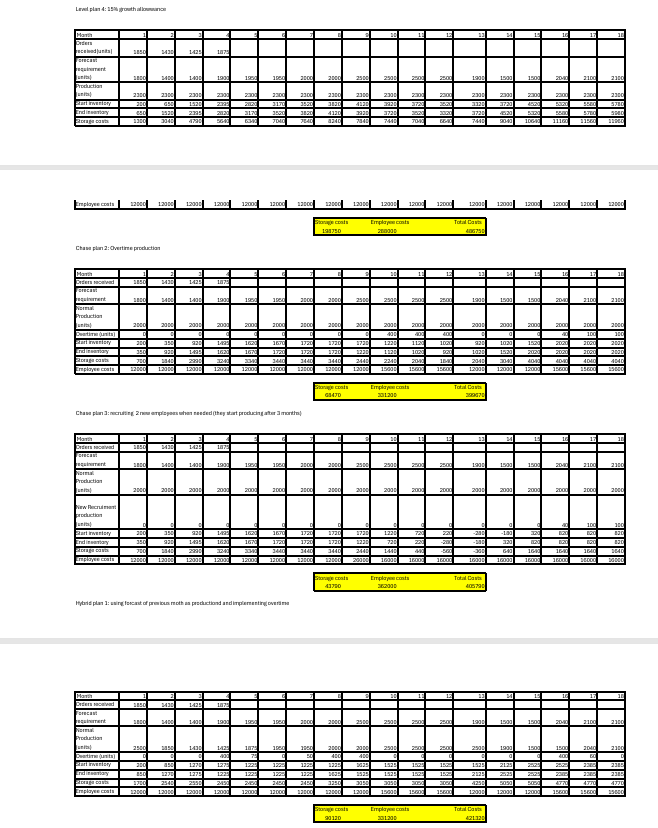
This project focused on analyzing various production scheduling strategies within manufacturing planning and control systems. It involved evaluating different scheduling approaches—Level, Chase, and Hybrid methods—to identify the most efficient and cost-effective solution for maintaining optimal inventory levels, controlling costs, and aligning production with fluctuating demand forecasts.
Objectives
- Develop multiple production scheduling plans (Level, Chase, and Hybrid strategies)
- Evaluate each plan's effectiveness based on cost efficiency, inventory management, and responsiveness to market demand variability
- Determine the optimal balance between storage and employee costs through comprehensive cost analysis
Methodology
The analysis involved creating detailed production schedules for an 18-month planning horizon, taking into account orders received, forecasted demand, production capacity, overtime capabilities, and the costs associated with inventory and employment.
Key Components
Key components of the methodology included:
Establishing Multiple Production Scenarios
- Level Production: Fixed monthly production of 2,000 units/month with or without growth allowances (5%, 10%, 15%)
- Chase Production: Production dynamically matched to forecasted demand
- Hybrid Plans: Combining Level and Chase approaches with overtime or new employee recruitment
Analysis Process
My analysis involved:
- Calculation and analysis of starting and ending inventory levels for each scenario
- Evaluation of costs associated with inventory storage and employee hiring/overtime
- Comparative cost-benefit analysis of each strategy to identify optimal scheduling methods
Results
The analysis highlighted significant differences in cost-efficiency across production plans:
| Strategy | Approach | Storage Costs | Employment Costs | Total Costs |
|---|---|---|---|---|
| Level Plan (No Growth) | Consistent 2,000 units/month | £82,230 | £240,000 | £322,230 |
| Chase Plan (Demand-Driven) | Production adapted monthly | £35,960 | £280,000 | £315,960 |
| Hybrid Plan | Overtime & Recruitment | £43,790 | £372,000 | £415,790 |
Key Insights
The Chase Plan demonstrated the lowest total cost, making it the most economically viable strategy for demand-responsive production scheduling. While the Hybrid Plan had relatively low storage costs (£43,790), its higher employment costs (£372,000) made it less economical overall.
Conclusion
Based on the comprehensive analysis, the Chase Plan emerged as the optimal strategy for production scheduling, offering the best balance between inventory management and workforce flexibility. This approach minimizes total costs while maintaining sufficient responsiveness to market demand fluctuations.