Digitization of Supply Chains
Final Year Individual Project
Project Overview
This final year individual project focused on leveraging blockchain technology to reduce the number of counterfeit parts entering the civil aviation supply chain. The aviation industry faces significant challenges with counterfeit parts, which can compromise safety and lead to substantial financial losses.
Objectives
- Develop a simulated aerospace database for single-point failure parts in a mock blockchain-based environment
- Execute realistic blockchain events to analyze performance
- Compare blockchain-based supply chain models against traditional aerospace supply chain models
- Propose a future state supply chain model for the aviation industry
Methodology
The project involved creating a comprehensive simulation environment that replicated the complexities of aerospace supply chains. By implementing blockchain technology, I was able to track and verify the authenticity of parts throughout the supply chain process.
Key components of the methodology included:
- Development of a blockchain-based database structure
- Implementation of smart contracts for automated verification
- Creation of testing scenarios to simulate real-world supply chain challenges
- Data collection and analysis to measure effectiveness
Results
The blockchain-based environment demonstrated a 70% counterfeit detection rate, significantly outperforming traditional supply chain models. This improvement in detection capability could potentially save the aviation industry millions in costs related to counterfeit parts and enhance overall safety.
Future Applications
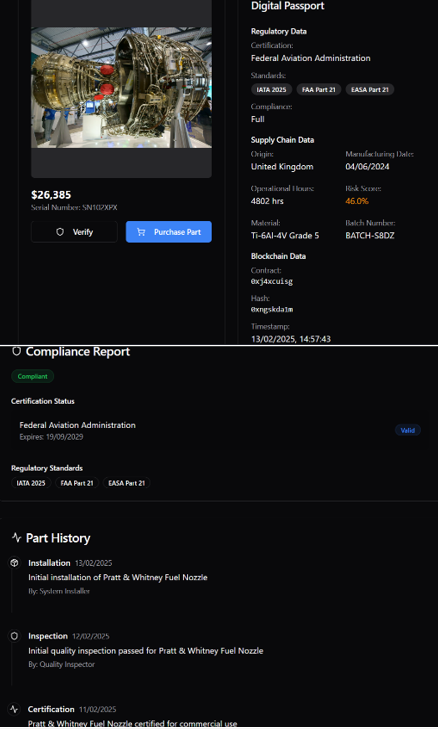
Based on the project findings, I proposed a future state supply chain model by building an app concept for a used aerospace parts marketplace based on blockchain technology. This marketplace would provide:
- Secure verification of part authenticity
- Complete part history and maintenance records
- Streamlined procurement processes
- Reduced risk of counterfeit parts entering the supply chain