Back to Projects
Digital Manufacturing and Discrete Event Simulation of Aerospace Landing Gear
Simulation Modelling Coursework
Project Overview
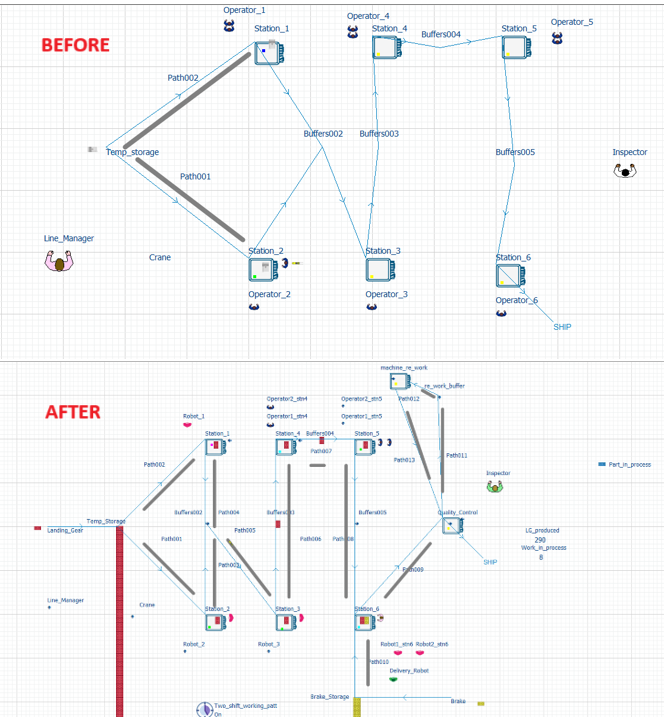
This project involved utilizing Witness Horizon software to perform Discrete Event Simulation (DES) for the assembly production of aircraft landing gears. The project evaluated and compared two different manufacturing scenarios—manual assembly with traditional labour versus automated assembly processes—to identify bottlenecks, optimize efficiency, and conduct comprehensive cost analyses for varied shift patterns.
Objectives
- Develop accurate digital simulation models for aircraft landing gear assembly
- Identify and analyze bottlenecks within different operational scenarios
- Compare traditional manual labour against automation in production efficiency
- Evaluate cost implications of varying shift patterns (single shift, extended shift, two-shift)
- Provide data-driven recommendations to optimize production processes
Methodology
The approach involved creating detailed simulation models using Witness Horizon software, including:
Scenario Development:
- Scenario 1 (Manual Assembly): Evaluating single shift (8.5-hour), extended shift (10-hour), and two-shift patterns
- Scenario 2 (Automated Assembly): Incorporating robotic automation and assessing operational efficiency
Bottleneck Analysis:
- Station-level analysis to identify production constraints and efficiency limitations
Cost Analysis:
- Detailed running-cost calculations per scenario, including labour, equipment, and overhead costs
- Comparative financial analysis to determine optimal economic strategies
Key Findings and Results
Scenario 1 – Manual Assembly:
- 8.5-hour single shift: Produced 166 landing gears monthly; cost per landing gear was approximately £595.70
- 10-hour extended shift: Increased production to 200 landing gears monthly; cost per landing gear was approximately £593.90
- Two-shift pattern: Maximized output to 336 landing gears monthly; cost per landing gear was approximately £762.80
Bottlenecks Identified:
- Station 3 caused delays at Buffer 2 due to slower processing compared to Stations 1 and 2
- Station 5 experienced delays due to operators prioritizing rework station activities
Scenario 2 – Automated Assembly:
- Implemented automation significantly increased production, achieving 340 landing gears monthly with an 8.5-hour shift pattern (including breaks)
- Automation reduced manual labour costs significantly, but initial investments in automation were substantial (£255,000 total for automated stations)
- Achieved monthly operational running costs at approximately £5,916/day
- After two years, the automated scenario yielded a total profit of approximately £8,160,000, clearly validating the investment
Recommendations and Innovations
- Transitioning from manual assembly to automated production would yield substantial long-term financial and operational benefits
- Automation of specific bottleneck-prone stations (Stations 3, 4, and 5) could further enhance productivity
- Adjusting automated cycle times to factor in equipment setup and crane operation ensured realistic simulation outcomes
Economic and Operational Benefits
- Reduced Labour Costs: Automation eliminated substantial manual labour requirements, decreasing ongoing operational expenditures
- Efficiency Gains: Automation significantly increased the monthly output of landing gears (by approximately 30%)
- Financial Viability: Automation investments recouped rapidly, achieving break-even within two years
Skills Applied
Discrete Event Simulation (DES)
Digital Manufacturing & Modelling
Production Optimization
Bottleneck Analysis
Cost Analysis
Financial Modelling
Witness Horizon Software
Strategic Decision-Making