Back to Projects
Automation of Flexible Manufacturing System
2nd Year Group Coursework
Project Overview
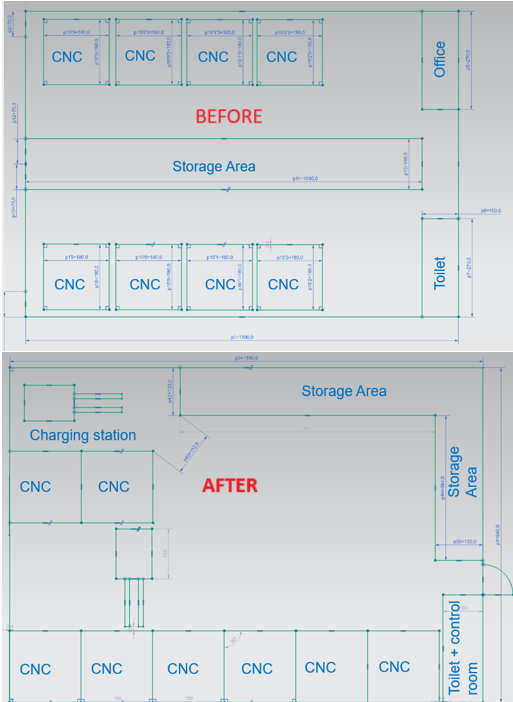
This project involved the strategic integration of advanced automation technologies into a Flexible Manufacturing System (FMS) to achieve lights-out manufacturing. The primary aim was to significantly enhance production flexibility, operational efficiency, and sustainability through state-of-the-art automation equipment and renewable energy solutions.
Objectives
- Develop and integrate a comprehensive multi-part machining strategy using CNC technologies
- Implement Automated Guided Vehicles (AGVs) for efficient material handling and warehouse operations
- Design and deploy an Automated Storage and Retrieval System (AS/RS) tailored for optimized inventory management
- Integrate automated tool management systems to minimize production downtime
- Adopt renewable energy sources (solar and wind) to reduce environmental impact and operational costs
Methodology
A systematic approach was utilized for this integration, focusing on:
- Analysis of existing manufacturing systems to identify automation potential
- Selection and deployment of advanced AGVs (EKS-215a from Jungheinrich)
- Installation of Automatic Tool Changers (HYCNC) to enhance CNC machining efficiency
- Implementation of AS/RS systems to streamline inventory management and reduce storage space
- Integration of renewable energy solutions (solar panels and wind turbines) to support sustainability and cost reduction
- Cost-benefit analysis for validating the economic viability of automation investments
Results
The integration of advanced automation and renewable energy solutions delivered substantial benefits:
- Improved production efficiency through automation, significantly reducing manual labour requirements
- Annual labour cost savings of approximately £188,000
- Energy savings through renewable energy:
- Solar Power savings: £11,645 annually
- Wind Energy savings: £128,772 annually
- Enhanced sustainability with reduced carbon footprint and reliance on traditional energy sources
- Projected maximum payback period of 5 years
Key Technologies and Innovations
The project implemented several cutting-edge technologies to achieve optimal automation:
- Automated Guided Vehicles (AGVs):
- Jungheinrich EKS-215a self-supported stacker with automated charging, cloud-based interfaces, and advanced safety scanners
- Load Capacity: 1500 kg, high flexibility, and extended battery life
- Automated Tool Changer:
- HYCNC Automatic Tool Changer capable of handling up to 10 tools simultaneously
- Benefits include reduced downtime and increased production consistency
- Automated Storage and Retrieval System (AS/RS):
- Selection of advanced Robotic Cube Storage System for optimal space utilization, efficiency, and scalability
- Enhanced accuracy, safety, and significantly reduced manual inventory handling
- Renewable Energy Integration:
- Solar Panel System: 62 panels, 420W each, generating approximately 47,523 kWh annually
- Wind Turbine System: Capable of significantly offsetting traditional energy consumption
Skills Applied
Automation Systems
Industry 4.0
Digital Twin
Manufacturing Systems
System Integration
Process Optimization