Back to Projects
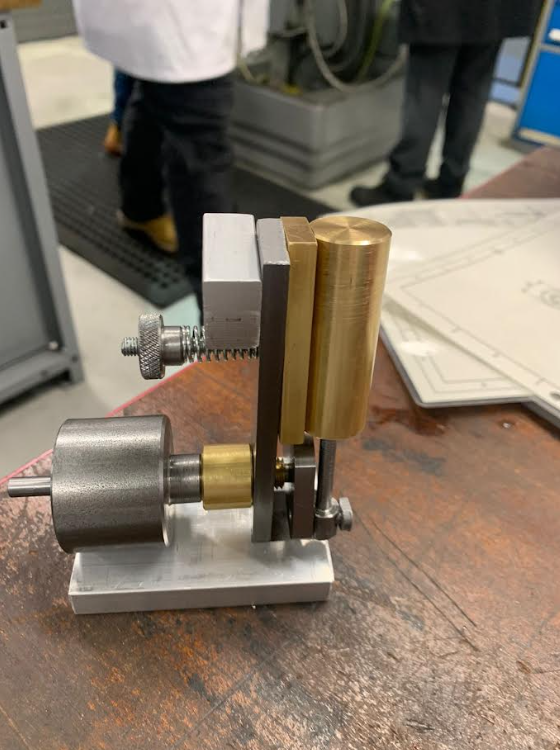
Air Engine Manufacturing & Testing
Engineering Management Group Project
Project Overview
In this practical engineering management project, our team designed, manufactured, and tested an Air Engine—a mechanical device converting compressed air into rotational mechanical energy. The primary goal was to build an efficient air engine capable of delivering the highest possible rotational speed using minimal air pressure. The project involved rigorous technical research, precise material selection, detailed manufacturing processes, and performance testing to meet provided specifications and engineering standards.
Objectives
- Manufacture an Air Engine using provided engineering drawings and raw material billets.
- Conduct in-depth technical research to ensure optimal component functionality and performance.
- Select suitable materials based on key properties like strength, accuracy, corrosion resistance, and machinability.
- Effectively manage project timelines, resources, and tasks through proactive planning and collaboration.
- Test engine performance under varying air pressures, analyzing rotational speed, voltage output, and component accuracy.
Methodology
The team implemented a structured approach combining engineering theory and practical skills:
Technical Research and Material Selection:
- Conducted extensive research into pneumatic motors, exploring functionality, efficiency, and industry applications.
- Selected suitable materials (steel, aluminium, and brass) considering properties such as strength, accuracy, machinability, weight, and corrosion resistance.
- Designed for manufacturability, balancing material strength with ease of handling and processing.
Manufacturing and Assembly:
- Manufactured individual engine components (base plate, flywheel, cylinder, manifold, crankshaft, connecting rod, piston, and additional fittings) according to detailed activity plans and technical specifications.
- Applied precision machining techniques including milling, turning, drilling, chamfering, and threading to meet tight tolerances.
- Assembled the engine collectively, carefully evaluating mechanical alignment, fit, and finish.
Testing and Validation:
- Performed rigorous internal testing (dimensional checks, thread quality, burr inspections, smoothness of operation).
- Conducted external performance testing by measuring rotational speed (rpm) and voltage outputs at varying air pressures (5 psi, 10 psi, 15 psi) using a tachometer, reflective tape, generator, and multimeter.
Results & Findings
- Successfully built an operational Air Engine, achieving rotational speeds of:
- 740 rpm at 5 psi, generating 0.44V
- 758 rpm at 10 psi, generating 0.59V
- 810 rpm at 15 psi, generating 0.68V
- Achieved high dimensional accuracy, meeting specified tolerances on 5 out of 6 critical components, demonstrating effective manufacturing precision.
- Identified and addressed manufacturing oversights, such as the improper machining of a screw pin, through internal testing and validation.
Practical Insights and Innovations
- Confirmed air engine suitability in applications demanding compact size, lightweight, and resistance to harsh environmental conditions.
- Demonstrated benefits of careful material selection (steel for durability and aluminium for lightweight and corrosion resistance) optimizing both performance and manufacturability.
- Highlighted the importance of rigorous quality control, including the introduction of checklists and meticulous verification methods to minimize assembly errors and air leaks.
Challenges & Lessons Learned
- Initially faced challenges with unfamiliar workshop equipment and precision tools (e.g., milling machines, lathes, and edge-finders), highlighting the necessity of better initial training and equipment familiarization.
- Experienced occasional setbacks due to dimensional inaccuracies and overlooked machining steps, reinforcing the importance of thorough and frequent checking of activity plans.
- Learned the value of effective time management and proactive planning, using Gantt charts and clear task assignments to keep the project on schedule and maintain team accountability.
Teamwork and Project Management
- Adopted structured project management practices including regular meetings, detailed minute-taking, and accessible progress tracking via shared Gantt charts and logbooks.
- Ensured clear communication, task delegation, and continuous peer support, resulting in efficient problem-solving and collaboration throughout the manufacturing and testing phases.
Skills Applied
Manufacturing and Machining Processes
Technical Research
Material Science
Project Management
Time Management
Precision Measurement
Quality Control
Pneumatic System Testing
Problem-Solving
Critical Thinking
Team Collaboration
Technical Documentation