← Back to Projects
SimaPro LCA Study: Aluminium vs PET Bottles for a Music Festival
Sustainable Product Lifecycle Engineering LCA Coursework
Project Overview
This project involved conducting a comprehensive Life Cycle Assessment (LCA) to evaluate the environmental impacts of two different water provision scenarios for festival attendees: refillable aluminium bottles versus single-use PET bottles. By leveraging detailed data analysis using SimaPro software, I assessed and compared the environmental footprints, emphasizing the climate change impact and a holistic single-score environmental measure.
Objectives
- Perform an in-depth LCA comparing the environmental impacts of refillable aluminium bottles against single-use PET bottles over a fixed functional unit (8 litres of drinking water per festival attendee).
- Determine which scenario resulted in lower environmental impacts based on climate change and overall single-score metrics.
- Conduct sensitivity analyses to identify the minimum refill threshold necessary for aluminium bottles to surpass PET bottles in environmental benefits.
- Clearly communicate LCA assumptions, system boundaries, and data sources, ensuring robust, credible analysis.
Methodology
Adopted a structured analytical approach aligning with international LCA standards:
Goal and Scope Definition
- Clearly defined the functional unit as the provision of 8 litres of drinking water per festival attendee over the event duration.
- Established clear system boundaries, explicitly excluding negligible impacts such as packaging, post-event usage, and infrastructure maintenance.
Life Cycle Inventory (LCI) and Data Analysis
- Employed SimaPro software to analyze detailed life cycle inventories across various lifecycle phases.
- Chose relevant data sources, including a credible 68% aluminium recycling rate (Circular Online, 2023).
- Conducted rigorous additional assumptions for precise calculations of energy consumption values.
Impact Assessment Results
- Climate Change Category:
- PET bottles: 2.93 kg CO₂-eq for the functional unit (16 bottles, 500 ml each)
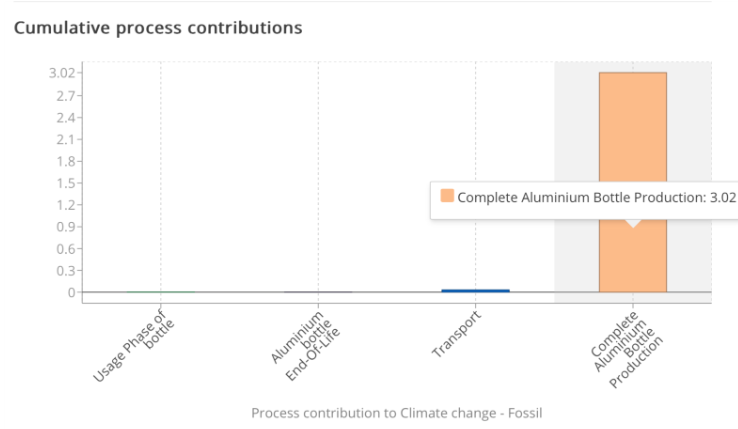
- Aluminium bottle: 3.06 kg CO₂-eq for one refillable aluminium bottle scenario
- Single Score Measurements:
- PET bottles scenario: 7.63e-5 Pt
- Aluminium bottle scenario: 7.95e-5 Pt
Key Findings and Insights
- Under the given functional unit, PET bottles showed slightly lower environmental impact in both metrics.
- Sensitivity analysis revealed that aluminium bottles become environmentally superior when reused at least 21 times.
- Consumer behavior significantly influences environmental outcomes, emphasizing the importance of public engagement.
- Recommended promoting aluminium bottle reuse at large-scale events through educational campaigns.